
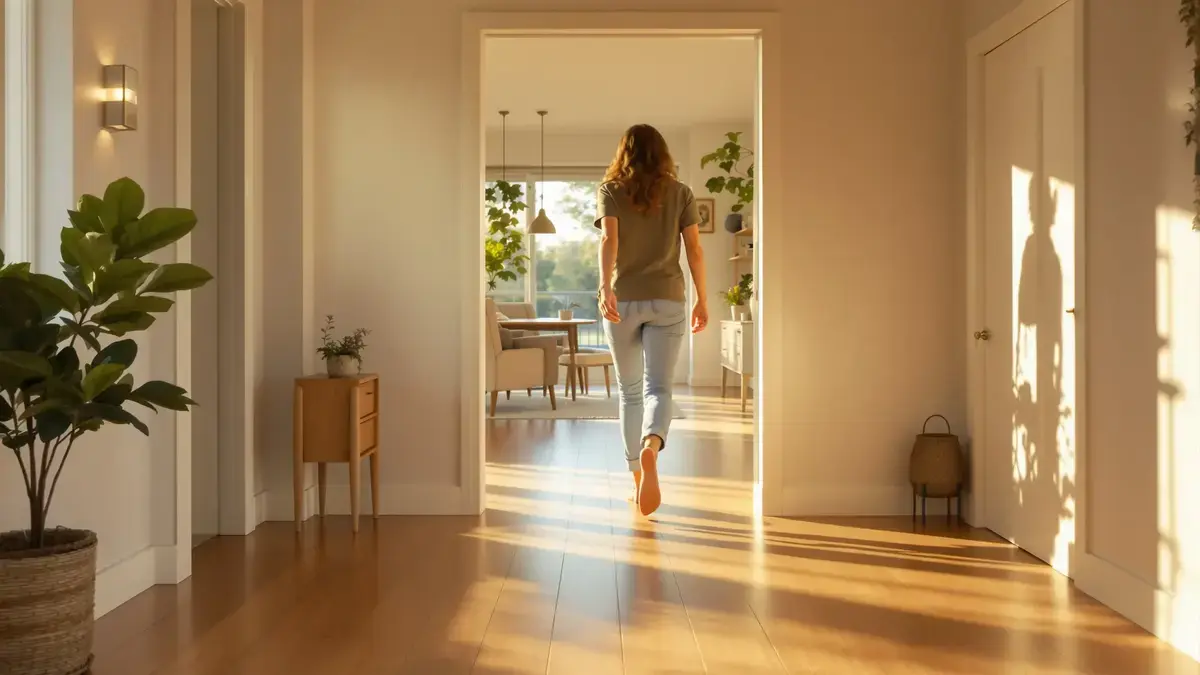

There’s a particular moment in the day—maybe late afternoon—when sunlight slides across the floor, stretching shadows into unexpected places. A child’s toy glides smoothly from one room to another, untouched by any bump or ridge in its path. Most would hardly notice. Yet something in the scene feels unusually expansive, as if the home itself is breathing a little more freely. The reason lies not in new furniture or a coat of paint, but within the barely considered seams that once split the floor under every doorway.
Light Moves Differently When Borders Fall Away
The door swings open. Where there was once the faint clink of metal or the stubbed toe against a bar, there’s only silence and the continuous brush of wood against skin. Threshold bars, those subtle ridges bridging one room’s floor to another, have long been the default—so ordinary, their disruption slips below notice. Yet their absence tells a new story.
The effect is immediate. A floor, uninterrupted, turns the home from a grid into a canvas. The eye glides from entryway to living room without pause, following the late winter light as it travels deeper into space. Spaces no longer feel boxed in. Rooms blur together, amplifying the sense of volume. Children dart between rooms without stumbling; the gentle flow encourages unhurried movement, a hallmark of what designers quietly call slow living.
Less Clutter, More Serenity
Without visual stop signs, something in the mind unwinds. Rooms shed a layer of invisible tension. Compartmentalization falls away, replaced by a quiet cohesion that makes even modest homes feel larger—sometimes dramatically so.
Beyond aesthetics, the changes are practical. No more slipped socks catching on a loose screw; no more dust gathering in the cracks that threshold bars foster. Cleaning slips easily from room to room. Even the pattern of wear, once betrayed by scratched or dented bars, becomes gracefully uniform across the years. As edges vanish, elegance surfaces in their wake.
Continuous Surfaces, Lasting Results
There’s a tangible confidence in choosing a single flooring—oak stretching from the hall into the kitchen, or concrete rolling on room after room. The effect isn’t only for those brave enough to renovate fully. Even a simple trick helps: where floors meet but levels align, an acrylic finishing joint erases the obvious divide. Matched in color, soft beneath the foot, this solution is invisible to all but touch. If warmth matters, a thin cork layer can be hidden beneath for extra comfort and insulation.
Suddenly, even homes with mixed materials—tile in the kitchen, wood in the den—achieve a kind of quiet unity. The space grows more inviting, its partitions softened.
A Small Change, A Subtle Shift
The cost is often less than expected. One cartridge of jointing compound replaces expensive metallic bars. The installation needs little more than a careful hand and a few hours, making this shift accessible even for the cautious do-it-yourselfer.
It’s a design detail that remains easy to overlook. Yet those who try it—removing just one threshold to start—often report a fleeting shock, followed by a stubborn sense of relief. The interruption has dissolved. Volume and unity take its place, changing how the home is moved through, and perhaps how it is lived in.
From Boundaries to Blank Canvas
Over time, these small adjustments accumulate. Spaces breathe wider, light roams farther, and routines shift almost imperceptibly. The floor becomes a discreet background, allowing furniture and daily life to take focus. Simplicity stands quietly at the center, inviting reconsideration of what truly needs dividing.
Furniture stands more pronounced, no longer hemmed in by invisible fences. The house feels less like a series of compartments and more like a flowing passage—a subtle nod to new architectural trends and to the growing desire for homes that feel both open and restorative.
The practice of removing threshold bars may seem like a minor design choice. Yet from dustless corners to liberated movement, the difference is woven throughout daily life. What was once a collection of rooms now unfolds as a single, connected space—less cluttered, more serene, unequivocally easier to live in.
